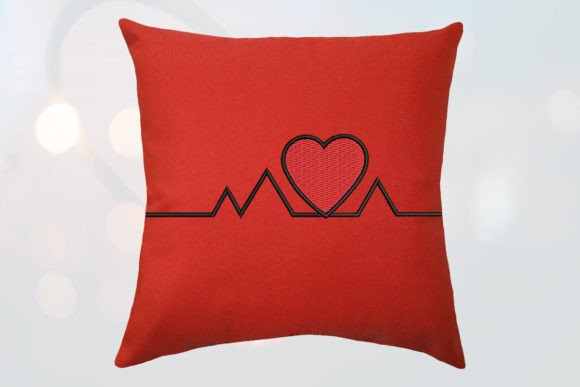
Heart ECG Embroidery Design Review
A Thoughtful Fit for Handmade & Commercial Projects
As an embroidery designer who’s stitched thousands of custom orders—from Etsy baby blankets to boutique apron collections—I approached the Heart ECG with quiet curiosity. It’s not just another Valentine’s Day motif; it carries a subtle, human pulse—clinical yet tender, modern but warm. Visually, it reads as clean and intentional: a stylized electrocardiogram line tracing a soft heart shape at its peak. There’s no excessive embellishment, no cartoonish flair—just confident line work and balanced negative space. That restraint is exactly what makes Heart ECG feel versatile rather than seasonal.
Where This Design Naturally Lands in Real Work
I tested Heart ECG across five real project types: a linen kitchen towel, a cotton baby blanket, a structured canvas tote bag, a midweight unisex sweatshirt, and a polyester pillow cover. In every case, it held up—not as a novelty, but as a considered design asset. On the towel, the rhythm of the ECG line echoed the gentle drape of fabric folds. On the baby blanket, it read as quietly meaningful—not cutesy, not clinical—ideal for gender-neutral nursery decor or early milestone gifts. And on the sweatshirt? It worked beautifully centered on the upper back, scaling cleanly without losing definition.
What stood out was how naturally Heart ECG supports storytelling in handmade products. A customer ordering a “nurse appreciation” embroidered tote didn’t need text—Heart ECG communicated profession, care, and warmth in one glance. Same for a grief-support pillow cover: dignified, not decorative. That emotional resonance elevates your handmade product beyond craft—it becomes context-aware design.
Practical Performance Notes You’ll Want Before Stitching
Heart ECG is a machine embroidery design, not an applique design—so expect satin stitch outlines and smooth fill stitch transitions where the heart form closes. I noticed moderate stitch density: enough to hold shape on stable fabrics, but not so dense it risks puckering on lightweight knits. That said, I’d avoid using it directly on highly stretchy jersey without added cutaway stabilizer and reduced top tension.
Hoop size matters here. The design fits comfortably in a 4×4 hoop—but only if scaled to ~3.75" wide. Going larger (to 5") introduces subtle thinning in the ECG waveform’s peaks and valleys. For caps or curved surfaces, stick to the smaller scale and test on a scrap cap blank first. Also, confirm the file includes both light and dark fabric colorways—some versions default to high-contrast thread choices that may not suit your brand palette.
On dark fabric, the design gains gravitas—especially when stitched in matte charcoal gray or deep burgundy thread. On light fabric, a crisp white or soft blush works best. Avoid yellow or neon threads unless intentionally aiming for medical-alert contrast. Always run a test on your exact fabric + stabilizer combo: I found tear-away worked well on towels and totes, but baby blankets needed lightweight cutaway to prevent shifting during the longer fill sections.
How Heart ECG Strengthens Your Product Strategy
For Etsy sellers and creative entrepreneurs, Heart ECG is more than decoration—it’s a subtle trust signal. Customers recognize medical, wellness, or caregiving themes instantly. When used on a personalized gift—a nurse’s embroidered apron, a therapist’s office pillow, or a new parent’s “heartbeat blanket”—it signals you understand their world. That builds buyer trust faster than generic hearts or florals.
Photography benefits too. The clean silhouette and rhythmic line make Heart ECG highly legible in flat-lay mockups and printable mockup templates. No busy background needed—you can style it against raw linen, concrete, or soft wool and still let the design carry the frame. That simplicity translates directly to stronger product thumbnails and social media engagement.
Commercial embroidery users will appreciate how easily Heart ECG integrates into existing workflows. It layers cleanly with monograms or small initials (try a discreet “J.M.” below the waveform), and its compact footprint leaves room for complementary elements—like a single running stitch arrow or tiny anchor icon—without overcrowding.
Smart Prep Steps Before You Download
- Check the Creative Fabrica product page for included file formats—ensure compatibility with your machine (e.g., .pes, .dst, .jef).
- Review licensing terms carefully: some Creative Fabrica embroidery files permit finished product resale, others restrict commercial use—verify before listing on Etsy or wholesale.
- Compare light/dark fabric mockups—if none are provided, stitch a quick sample on both to assess thread visibility and balance.
- Inspect small details post-stitch: the tip of the ECG peak and inner heart curve should be sharp, not frayed or under-stitched. If they’re soft, try tightening top tension slightly.
- Confirm stabilizer pairing: medium-weight cutaway for knits, lightweight tear-away for stable wovens, and fusible + tear-away for layered pillow covers.
A Design That Earns Its Place
Heart ECG won’t shout—but it lingers. It’s the kind of digital embroidery file that feels like a quiet upgrade to your design assets: professional, emotionally intelligent, and technically sound. It doesn’t chase trends; it meets real needs—caregiver appreciation, medical awareness, heartfelt gifting, and understated Valentine S Day sentiment without cliché.
If you embroider for people—not just products—Heart ECG is worth adding to your collection. Not as filler, but as focus. Use it where meaning matters more than mass appeal. Stitch it where someone will trace the line with their finger and feel seen.